
VCD302

Before I talk about my proposed animation for this motion design project, I would like to draw your attention to the word Dyslexia. Do you know what Dyslexia is?
For those of you who do not know, the International Dyslexia Association state:
“Dyslexia is a specific learning disability that is neurobiological in origin. It is characterized by difficulties with accurate and/or fluent word recognition and by poor spelling and decoding abilities. These difficulties typically result from a deficit in the phonological component of language…”
There is numerous information that describes what dyslexia is, however, there is not a lot of accurate visualizations that show what Dyslexia looks like from a Dyslexic brain and perspective.
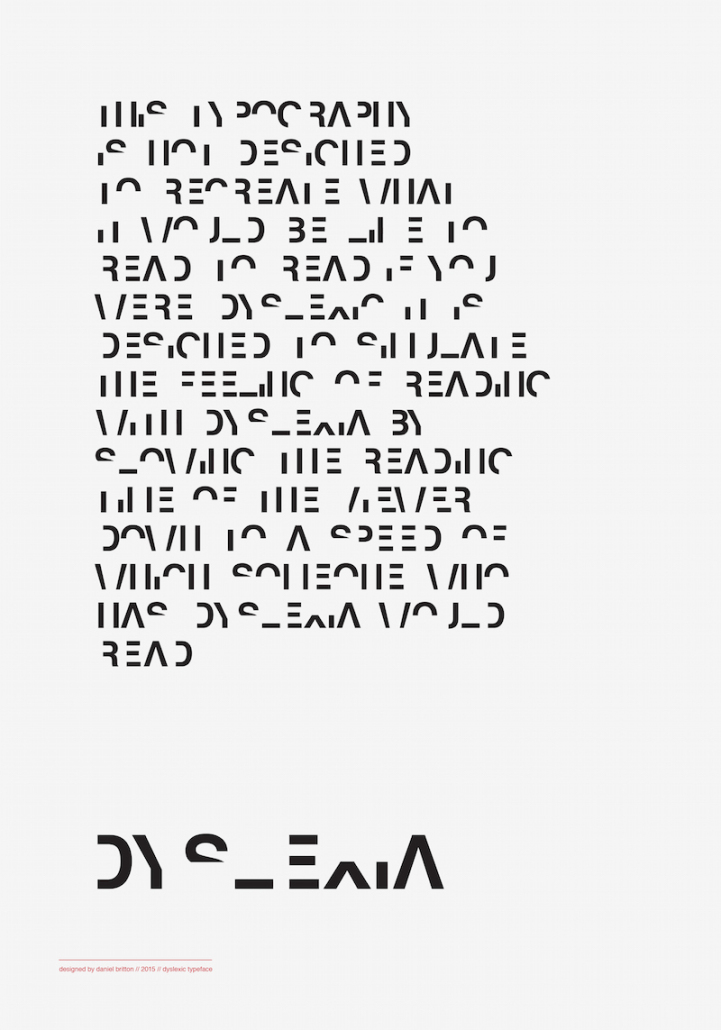
Graphic designers are realising this gap and are starting to communicate Dyslexic struggles through typeface design and illustration. The work below by Daniel Britton, who at 22 years old designed this typeface to recreate the feeling of reading with Dyslexia for a non-Dyslexic person, therefore creating empathy and understanding for the problem. Like Daniel, I hope to advocate awareness for Dyslexia through my animation project.
British graphic and motion designer Josh Penn has created a animation that communicates what it is like to have Dyslexia through kinetic type. Penn’s design is effective as it accurately imitates what reading can look like through a Dyslexic mind. He has done this through transitions of morphing letters, such as d into b, lines of kinetic type breaking apart and reforming, and camera panning. These techniques show, over tell, a natural decoding process of a Dyslexic mind. Like, Penn I hope to use kinetic type to convey what reading looks like from a Dyslexic perspective. However, my animation’s informational content will not focus on Dyslexia as a disability, rather as an ability.
I have chosen to focus on individual strengths in the topic of Dyslexia as there is a lack of understanding around neurodiversity within the general public. Educational information often focuses on the negative symptoms of Dyslexia and other neurodiversity conditions, rather than Dyslexia’s unique abilities. Statistically 1 in 5 people have Dyslexia, however, as little as 3% of the population understand Dyslexia as a strength. This creates a gap in information that could potentially communicate a positive narrative, a narrative I wish to address in my animation project.
‘Made By Dyslexia’ is a non for profit charity that is addressing this informational gap by informing their viewers about Dyslexic strengths through case studies of people who became successful due to their Dyslexic thinking, EG Orlando Bloom and Steve Jobs. It is this kind of information that empowers individuals with Dyslexia as it proves how this disability can be used as an advantage and ability.
This is clear in the strengths that commonly form in those with Dyslexia, such as:
- People with dyslexia excel at visual processing and the detection of impossible figures. Thus, many people with dyslexia are in the field of astrophysics- due to their sensitivity to “things out of place.”
- Strong strategic and creative thinking. Entrepreneurs like Thomas Edison, Henry Ford, Steve Jobs and Charles Schwab were all dyslexic.
These facts are relevant to my project because I hope to include these abilities as the primary content for this potential educational infographic animation on Dyslexia strengths. Like ‘Made By Dyslexia’, I hope to cause a better understanding of the dual nature of Dyslexia, whilst empowering viewers who may have the condition.
My animation will take the form of a public educational infographic and will rely heavily on illustrative images and kinetic type. I have chosen to focus on an illustrative and kinetic type motion design animation as this could show a Dyslexia perspective of words visually moving on pages, letters morphing and sentences waving out of line when being read. I am interested in experimenting with after affects to achieve a realistic view of Dyslexia at work to that of a non-dyslexic. This can be seen in my early-stage comp one development.
Outcome (form/scope):
- Kinetic type and illustrations that animates in such a way that it imitates the decoding process.
- 2 minutes in length
- 5 strengths- case studies
- Public- music- royalty free
- Record my voice?
Thanks for the read, until next time, have a good one!
 Millie Captions